
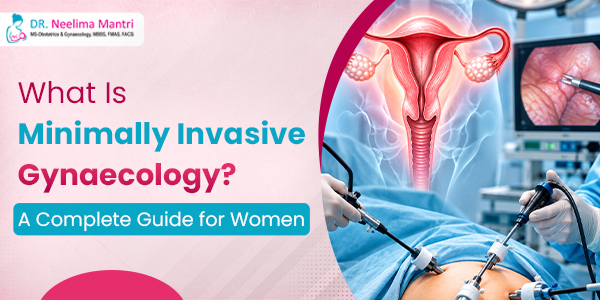
For decades, gynaecological procedures carried a reputation that made women uneasy and intimidated.
Standard procedures were open surgeries with large incisions and bulky instruments. Operating times were longer, and recoveries stretched for days. And then, with high blood loss, there was a greater risk of complications. But gynaecological surgery has undergone a radical shift in the last two decades with the rise of minimally invasive surgical procedures.
What Is Minimally Invasive Surgery?
Smaller incisions, tiny instruments, less tissue disruption, and faster recovery – this is how one can describe minimally invasive surgical procedures.
To elaborate, minimally invasive surgery refers to procedures performed through very small incisions (sometimes only a few millimetres), instead of one large open incision. Minimally invasive surgeons use specialized instruments & tiny cameras to access the body, and high-definition monitors to see inside the body and perform procedures with remarkable precision.
That said, minimally invasive surgery is not simply about making smaller cuts; it represents a systemic change in how gynaecological surgery is performed. The ultimate goal is to combine advanced technology, specialized instruments, and surgical expertise to treat the gynaecological condition while minimizing unnecessary disruption to surrounding tissues.
To summarize:
| Factor | Traditional Open Surgery | Minimally Invasive Surgery |
| Incision size | Large (several inches) | Small (a few mm) |
| Hospital stay | Several days | Often same-day or overnight |
| Recovery time | Weeks | Days to about a week |
| Post-operative pain | Higher | Lower |
| Scarring | Prominent | Minimal |
| Risk of infection/complications | Higher | Lower |
| Blood loss | Higher | Minimal |
Which Gynaecological Conditions Can Be Treated with MIS?
“In gynaecology, this procedure most commonly takes the form of laparoscopic surgery and, increasingly, robotic-assisted surgery. Gynaecological surgeons access the surgical site through a few small ports, guided by a magnified, real-time view of the internal organs on a monitor. And this gives these procedures the ability to diagnose and treat a wide range of gynaecological conditions today,” says female gynaecologist in Mumbai Dr Neelima Mantri who also specializes in minimally invasive gynaecology in Mumbai.
Some of the common gynaecological conditions that are today leveraging minimally invasive surgery procedures include:
• Ovarian cysts
• Fibroids (myomectomy to remove fibroids while preserving the uterus)
• Endometriosis
• Hysterectomy (removal of the uterus, for various benign and some malignant conditions)
• Ectopic pregnancy
• Pelvic organ prolapse
• Infertility-related conditions, such as blocked fallopian tubes or adhesions
• Abnormal uterine bleeding
• Certain early-stage gynaecological cancers, depending on the case
Why Surgeon Expertise Still Matters – A Lot
Owing to its remarkable ability to make gynaecological procedures simple, convenient, and efficient, minimally invasive surgery has brought a radical transformation.
But there is an important caveat: minimally invasive surgery is a highly skill-dependent field.
When incisions and instruments are smaller, the margin for error is tighter, and the gynaecology surgeon works with a two-dimensional view of a three-dimensional space. This calls for exceptional spatial judgment, and hand-eye coordination and expertise developed only through advanced training and years of experience in minimally invasive procedures.
Few gynaecologists in Mumbai have years of experience in tertiary care, few have years of experience in minimally invasive laparoscopic procedures, and very few gynaecological surgeons have years of experience in minimally invasive procedures that cover the full range of gynaecological procedures. Dr. Neelima Mantri belongs to this rare group of minimally invasive gynaecological surgeons in Mumbai, with more than a decade of experience treating the full range of gynaecological procedures using minimally invasive techniques.

